With the recent news that a joinery company in South East England was fined £20,000 for failing to control its employees’ exposure to wood dust, you may be wondering about your requirements to control exposure to wood dust and how exposure affect the health of your employees.
Wood dust can cause asthma, and carpenters and joiners are four times more likely to get it compared to other UK workers, and hardwood dust can even cause cancer, particularly of the nose.
So what's an acceptable amount of Wood Dust?
The Workplace exposure limit (WEL) is different for both softwood and hardwood.
For hardwood the WEL is 3mg/m3 (based on an 8-hour weighted time average).
For softwood the WEL is 5mg/m3 (based on an 8-hour weighted time average).
Where a mix of both hardwood and softwood dust is present, the WEL for hardwood should be adhered to for all wood dust present.
To ensure you are adequately controlling the amount of wood dust in your working environment you should:
- Apply the eight principles of good control practice.
- Keep exposure below the WEL relevant to the type of wood being used.
- Reduce exposure to a level which is as low as reasonably possible.
How can I reduce exposure?
Dust extraction via local exhaust ventilation (LEV) at woodworking machines will capture and remove dust before it can spread the system should be designed with the number and type of the machines that it will be connected to in mind. The layout of the factory should also be considered.
Workers should be informed of the risks of exposure and the control measures which are required. They should be shown how to use the extraction system to prevent misuse.
It is important to ensure your extraction system is working correctly and it is a legal requirement to have a competent person examine the system at least every 14 months.
In certain situations, such as when jobs are being performed which produce a large amount of dust, Respiratory protective equipment (RPE) may be required. It is important that the right type of RPE is being used, that it fits well, and that it is being maintained/changed in accordance with the manufacturer’s instructions.
How do I know if my control measures are doing enough?
As exposure to wood dust can cause asthma and other health issues it is important to spot any health effects early.
The way to do this is by putting in place…
*drum roll*
a health surveillance programme.
A suitable Health Surveillance programme covering workers exposed to wood dust should include:
A health assessment before exposure begins to provide baseline results. If not possible, then an assessment should be performed as soon as possible after first exposure.
Ongoing assessments should then be performed at regular intervals. This will usually be annually, but your Occupational Health provider () can advise on the required frequency for your business’ individual requirements.
A questionnaire to establish medical history and current health situation.
A spirometry test.
Results for Health Surveillance assessments should be analysed both for each individual, and as a group of similarly exposed workers (along with any previously recorded results). This will enable any weaknesses in your risk assessments and control measures.
Can Aardvark provide my employees with Health Surveillance?
Of course! What’s more, with our fleet of Mobile Medical Centres we can come to your site with everything we need to perform the required assessments, minimising the disruption to your team.
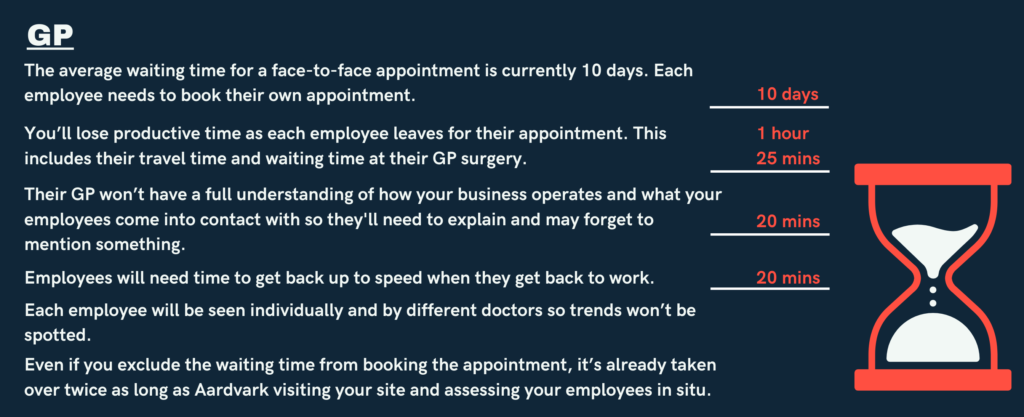
Aardvark vs. GP